Strait of Hormuz Closure Triggers Global LNG Shockwaves

Escalating Middle East conflict halts Qatari LNG exports, tightening global gas markets and driving renewed volatility in Australian electricity futures.

The escalating war in the Middle East has forced the world’s second largest liquefied natural gas (LNG) producer, Qatar, to halt operations. At the centre of this disruption is the Strait of Hormuz — one of the world’s most critical maritime trade routes for oil and LNG.

Iran has reportedly warned shipping not to traverse the Strait, and tanker traffic through the waterway has effectively ceased for the time being. This closure presents a significant risk of disruption to global oil and LNG markets, at a time when supply balances remain sensitive.

A Major Shock to Global LNG Supply

According to Wood Mackenzie, nearly 20% of global LNG transited the Strait of Hormuz in 2025. A halt in flows through this corridor would dramatically tighten global LNG markets and place immediate upward pressure on prices.

In addition, Woodmac has warned that the scale of disruption could be “comparable in scale to the curtailment of Russian gas supplies to Europe four years ago” — an event that triggered extreme volatility and sustained price increases across global energy markets.

With Qatar halting operations and vessel traffic paused, the market is now pricing in the risk of extended supply disruption.

Flow-On Impacts for Australia

Australia is not insulated from these global dynamics. Domestic gas and electricity prices are strongly correlated with international LNG markets, meaning sustained disruption is likely to influence local pricing.

This week, electricity futures have already begun responding:

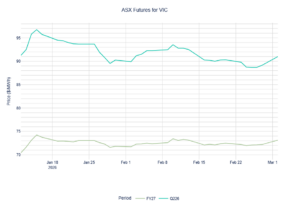
  • NSW Q2 2026 futures rose 6.58% week-on-week

  • VIC Q2 2026 futures rose 6.57% week-on-week
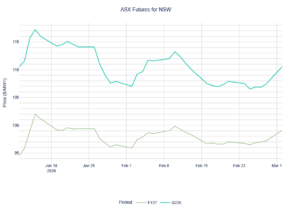
 

An extended conflict or prolonged supply interruption could reverse the downward trend seen in electricity futures over recent months, increasing cost pressure for energy users.

A Rapidly Evolving Situation

This is a fast-moving geopolitical and energy market event. The duration of the disruption — and whether LNG flows resume in the near term — will be critical in determining the magnitude and persistence of price impacts.

We are closely monitoring developments across global LNG markets and Australian electricity futures.

If you’re interested in how this escalating situation might impact your electricity cost, please contact us.

AEMC Confirms Higher Market Price Cap for FY27, with the Cumulative Price Threshold to Rise from July 2026

AEMC Publishes their Increase to NEM Reliability Settings for FY27

On 26 February, the Australian Energy Market Commission (AEMC) published its annual update to the National Electricity Market’s (NEM) reliability settings, confirming that the Market Price Cap (MPC) will rise from $20,300/MWh in FY26 to $23,200/MWh for FY27.

The Cumulative Price Threshold (CPT) will also increase to $2,225,900/MWh from 1 July 2026.

What Do These Changes Mean?

The Market Price Cap (MPC) is the maximum price that can be reached on the spot market during any dispatch and trading interval.

The Cumulative Price Threshold (CPT) is a safeguard mechanism. It acts as a trigger to end a sustained seven-day period of extremely high prices in the wholesale electricity market.

Under the new settings, the CPT will be breached if:

  • The spot price reaches the MPC for 96 five-minute intervals (8 hours), or

  • The spot price averages $1,104/MWh over a week,

When this occurs, the Administered Price Cap (APC) is triggered, capping wholesale electricity prices at $600/MWh. The APC remains in place for subsequent days if the CPT continues to be exceeded.

Why These Settings Matter

The NEM is an energy-only market, meaning generators are paid only for the electricity they produce, not for maintaining available capacity.

These price settings — which remain the highest price caps in the world — have no impact on wholesale electricity prices more than 99% of the time. However, they play a critical role during periods of tight supply by:

  • Encouraging additional generation into the market

  • Supporting system reliability during supply shortages

  • Providing incentives for investment in dispatchable capacity

In short, the MPC and CPT settings are designed to ensure supply is available when the system needs it most.

Risk Implications for Spot-Exposed Consumers

While high-price events are infrequent, their impact can be material.

Under the new MPC, a single five-minute interval at the MPC can increase the quarterly average spot price by approximately $0.90/MWh. This presents a meaningful risk for consumers exposed to spot pricing.

So far in FY26, the spot price has reached the MPC:

  • 6 times in NSW

  • 5 times in South Australia

  • 2 times in Tasmania

As volatility events become more common during periods of system stress, understanding exposure to high-price risk remains critical for energy users.

If you’d like to gain insight into how you can manage volatility under the new settings, please get in touch with our team at Edge2020.

The AER’s NSW Electricity Infrastructure Roadmap Contributions Rise Again

A breakdown of the 2026–27 contribution determination and how rising network and scheme charges are flowing through to NSW electricity bills.

On 11 February 2026, the Australian Energy Regulator (AER) released its contribution determination for cost recovery under the NSW Electricity Infrastructure Roadmap for the 2026–27 financial year, in accordance with the NSW Electricity Infrastructure Investment Act 2020.

These annual costs are passed through by the three NSW distribution network service providers (DNSPs) to NSW consumers as part of the network component of electricity bills.

The total contribution determination for 2026–27 is $593.16 million.

The amounts required to be paid by each NSW distribution network service provider (DNSP) are:

  • Ausgrid: $254.23m

  • Endeavour Energy: $221.40m

  • Essential Energy: $117.53m

These contributions have increased significantly over recent years. And for many customers, these scheme-related costs are becoming a more noticeable driver of network charges.

For context: between FY25 and FY26, flat tariffs for small business customers increased by:

  • Ausgrid: 9.6%

  • Endeavour Energy: 9.5%

  • Essential Energy: 7.9%

Notably, almost half of this increase was driven by additional transmission and jurisdictional scheme costs — including NSW Roadmap costs.

If you would like to understand what this means for your organisation’s electricity costs, please reach out to the Edge2020 team. 

Quorn Park signals a new era of hybrid solar-BESS projects

A case study showing how hybrids can boost commercial results and improve system performance as the NEM evolves.

Located near Parkes, NSW, Quorn Park combines 98 MWdc/80 MWac of solar with a 20 MW two-hour battery behind a single connection point as the NEM’s first large-scale hybrid to connect under one Generator Performance Standard (GPS).

We’re heading into a ‘Wave of 2026’ – around 4-6 projects that reached financial close in 2024/25 are expected to start commissioning this year using the single-GPS model. Nearly all new applications for combined solar and battery sites (15+ projects) are now opting for the single GPS model, signalling that it is quickly becoming the new normal.

Historically, if you had a solar farm and a battery at the same location, AEMO treated them as two completely separate machines with two different sets of instructions. Quorn Park is one of the first projects to utilize the Aggregated Dispatch Conformance (ADC) rules, which treat the whole facility as a single “black box” at the connection point. That “true hybrid” approach delivers three big advantages:

1. More valuable energy from the same assets: By storing solar during high-generation periods and dispatching later, the battery helps firm output and shift energy into higher-value intervals. It reduces bidding complexity and also opens the door to revenue stacking, including participation in services like FCAS, improving overall project economics.

2. Better grid outcomes and dispatch alignment: A key operational benefit is tighter conformance with AEMO dispatch targets through Aggregated Dispatch Conformance (ADC) under the IESS reforms. In practice, the battery can respond rapidly to smooth variability and maintain a near-perfect conformance record – supporting grid stability and reducing the risk of performance penalties.

3. Lower duplication and a clearer connection pathway: Because the solar and battery share infrastructure and compliance under a single GPS, the hybrid design can reduce duplicated equipment, streamline approvals and improve cost efficiency versus separate connection approaches.

Now energised and in commissioning/testing, Quorn Park is targeting full operation in H1 2026 – and it’s a useful case study for how hybrids can improve both commercial performance and system outcomes as the NEM evolves.

At Edge2020, we’re committed to keeping you informed about energy market trends and changes that may impact your business. If you’re interested in understanding how this particular trend could affect your organisation, please get in touch with us.

Monthly Energy Market Summary for August 2025

August 2025 Market Wrap: Transition Gathers Pace Amid Grid and Policy Challenges

August 2025 marked a pivotal period in Australia’s energy transition, with new records in renewable generation, evolving forecasting methodologies, and further commitments from government and industry to reshape the national electricity landscape. Several major developments will have implications for large energy users, particularly as coal exits, demand grows, and grid capacity remains under strain.

The release of the 2025 Electricity Statement of Opportunities (ESOO) reaffirmed growing reliability risks in the coming decade, particularly in NSW and Victoria. While AEMO’s modelling shows the NEM may meet the reliability standard under a scenario where all “actionable” transmission projects and Commonwealth Capacity Investment Scheme (CIS) initiatives proceed smoothly, this is a best-case outlook. Escalating project costs—such as VNI West—and the potential for delays mean there is little margin for error. As such, many observers have expressed concern about the “all-must-go-to-plan” nature of current planning assumptions.

In parallel, AEMO announced a shift in demand forecasting methodologies, aiming to better capture the impact of electrification, artificial intelligence, data centres, and future fuels on electricity loads. This update is especially important as industrial users ramp up electrification efforts and as distributed energy technologies increasingly influence consumption patterns. Accurate, adaptive forecasting will be essential for investment planning and contract strategies.

Generation dynamics also continued to evolve. The NEM saw new monthly records for utility-scale wind and solar output, driving down spot prices and reducing coal generation to historically low levels. These trends reflect both seasonal advantages and structural change. At the same time, batteries continued to break new records for charging and discharging, underlining their growing role in supporting system flexibility.

From a policy standpoint, the Federal Government’s Rewiring the Nation program progressed with renewed momentum. This multi-billion-dollar initiative, backed by concessional finance via the Clean Energy Finance Corporation, aims to accelerate critical transmission investments identified in AEMO’s Integrated System Plan (ISP). August also saw development approvals for Victoria’s Wombelano Wind Farm, the first major wind farm approval in the state in several years. Such projects are vital to relieving capacity constraints and enabling additional renewables to connect to the grid.

Meanwhile, AGL signalled it may mothball or cycle coal generators over weekends to accommodate solar generation, highlighting the challenges of maintaining ageing thermal assets amid low daytime prices. The move also reinforces the growing financial pressures coal generators face and may foreshadow more frequent operational flexing or earlier retirements.

In the environmental markets, certificate prices remained relatively firm, but volatility persists as policy and market uncertainty influences trading dynamics.

At Edge2020, we continue to monitor these developments closely. With over 10 TWh and $1 billion in energy spend under management, our priority remains supporting our clients through tailored insights, proactive risk mitigation, and forward-looking procurement strategies. As market complexity grows, staying informed and agile will be essential.

The Nelson Review: A Welcome Refinement of the NEM

At Edge2020, we view the August 2025 draft of the Nelson Review as a timely and pragmatic step toward strengthening the National Electricity Market (NEM) without discarding its foundations.

The Review offers a measured and market-focused approach that acknowledges the evolving nature of Australia’s energy system while preserving the core design features that continue to support efficient outcomes.

Australia’s electricity market has changed dramatically over the past decade. The generation mix is now more weather-dependent, decentralised, and variable. These shifts have placed new demands on the market, challenging its ability to deliver reliable investment signals and maintain system security. The Nelson Review recognises that while the energy-only spot market remains valuable, it must be updated to reflect today’s operating environment better.

A key recommendation is the improved integration of flexible and price-responsive resources. This includes battery storage, aggregated demand response, virtual power plants, and distributed energy technologies such as rooftop solar and home energy systems. Greater visibility and participation of these resources in dispatch are positioned as essential steps toward building a more dynamic and reliable grid.
To address the gap between short-term market signals and long-term investment needs, the Review proposes a new Electricity Services Entry Mechanism.

This process would support the competitive procurement of standardised contracts for firming, shaping, and bulk energy services. Contracts would be awarded through reverse auctions, helping to create investment certainty without undermining existing market structures. This approach is designed to reduce reliance on short-term interventions and provide a more stable pathway for private investment.

The Review also places significant focus on improving the contract market. With greater price volatility and growing interest in financial risk management, improving transparency and liquidity is critical. The Review suggests actions such as enhanced disclosure of contract terms and potential obligations for large participants to support market depth. These improvements aim to strengthen the ability of all market participants—retailers, generators, and large energy users—to manage their positions effectively.

Overall, the Review sets a clear direction. It does not seek to replace the NEM’s foundations but rather to refine and strengthen them. The proposed reforms are practical, proportionate, and aligned with the long-term interests of the market.
As consultation continues, Edge2020 will engage with clients and stakeholders to interpret the implications and ensure readiness for what lies ahead. We welcome the Review’s direction and believe its implementation can help reinforce market confidence, improve investment outcomes, and support the energy transition already underway.

The Woe of Callide

The woes at Callide Power Station continue to deepen and have claimed yet another casualty.

Sources indicate that on 4 April, a significant clinker (a mass of hardened ash) detached from the boiler wall in the C3 unit. While clinker formation is not unusual in coal fired power stations, routine maintenance typically addresses such issues during outages. It appears that this clinker broke away during the unit’s operation, causing the ash conveyor water system to release high pressure steam into the boiler.

It has also been reported that the steam from the ash conveyor water system subsequently extinguished the fires in all four mills, which process coal into pulverised fuel (PF) to fire the boilers. As a result, the boiler flames in the four mills were snuffed out, and the unit experienced a pressure fluctuation as it drew in unburned fuel and air. This fluctuation allegedly led to an explosion that caused extensive damage to the unit and its boiler.

Fortunately, no workers were in the vicinity at the time. However, significant repair work is now required, including in the hard-to-reach upper sections of the boiler, where extensive cladding and lagging repairs must be undertaken.

The political fallout continues to swirl. CS Energy CEO Darren Busine has already tendered his resignation, which has now been made immediate. There is also speculation that the General Manager of Callide Power Station has offered their immediate resignation.

Concerns have arisen around the LNP Queensland Government, specifically regarding what David Janetzki knew and when he knew it, particularly given his 8 April address to the Queensland Energy Club. In that speech, he announced coal and Callide would continue to play an ongoing role in Queensland’s energy mix beyond Callide B’s expected 2028 closure (at least another three years) with no mention of the recent explosion or the seriousness of the incident.

This event evokes memories of the Callide C4 explosion in May 2021, whose outcomes were finalised in February 2025 when the Australian Energy Regulator (AER) imposed a $9 million fine plus court costs on the joint venture for the Callide C4 unit. The fine, just shy of the maximum $10 million possible, was the highest ever imposed for failure to comply with performance standards under the National Electricity Rules (NER). The retailer was found to have breached the NER by failing to meet its own performance standards, and investigations revealed that there was insufficient energy supply to safely disconnect the generating unit when the explosion occurred. Furthermore, the protection systems intended to override the connections were found to be inadequate.

The incident report also noted that, two minutes after staff evacuated due to a fire, a two-tonne rotor shaft piece was thrown five metres across the turbine hall floor, while a 300kg piece of equipment was hurled 20 metres into the air, breaking through the hall’s roof.

Election finally called – Energy takes front and centre stage

Well, the long-anticipated election has finally been called. While the division between parties widens, the stakes for both large and small electricity users and emitters couldn’t be higher.

With Labor finally admitting they cannot make energy cheaper, they had promised in the last election that by 2025, energy costs would be $275 lower per household. However, their all-in renewables plan has only pushed them further from this goal, with rising wholesale electricity costs and transmission development blowouts driving prices even higher.

The latest example is TransGrid’s Project Energy Connect, which is both over budget and significantly behind schedule. The costs will ultimately be passed on to end users through tariffs. This is further compounded by other projects, such as the Marinus Link, where stage one alone is estimated to cost around $4 billion, already 17% over budget, despite construction not being scheduled to begin until 2026. Costs are likely to rise even further across both stages. Additionally, changes like the reform of Frequency Control Services payments, set to take effect by June 2025, will continue to drive up costs for end users.

It is likely the reason Labor used their final budget to extend the electricity rebate for a further 6 months, nothing like using a band-aid to stem the bleeding.
However, this will do little to offset the expected 8.9% increase in the default price set by the AER for the next financial year. With no control over these pass-through costs, end users will bear the brunt, and a $150 rebate over six months won’t come close to covering the rising costs, regardless of how long subsidies last.

The Liberals are also making enemies in parts of the industry. While they remain committed to their much-debated nuclear plan, the interim would need to be covered by a gas reservation scheme, requiring suppliers to divert 10–20% of their output from the international market into domestic supply chains for gas generation and household use, a move that producers are unlikely to welcome.

To appease the industry, the Coalition is promoting a relaxation of the safeguard mechanism, which may explain the declining appetite for SMCs and ACCUs, along with their falling prices. The incentive for increased supply could come from removing best practice baselines for new gas projects, while a potential reduction in baseline reduction rates is being floated as a way to secure industry support.

What is evident as we enter the first full week of campaigning is that energy is a hot topic and will be one of the significant cornerstones of both parties’ campaign strategies.

Gas Statement of Opportunity

After years of the government placing their heads in the sand on the East Coast Gas Crisis, which is about to engulf the Australian market, the Gas Statement of Opportunities (GSOO) and the government are finally recognising that the status quo will no longer work.

AEMO’s CEO, Daniel Westerman, has emphasised the severity of the situation, noting that the Longford plant is set to retire in 2033 and will likely see reductions leading up to that point. Longford supplies two-thirds of the East Coast gas supply, and with Bass Strait fields depleting and coal closures imminent, new investment in gas supply is imperative.

The gas gap, the difference between supply and demand, remains from 2028/2029, making investment decisions critical to ensuring supply security from that time. The GSOO has touted solutions such as LNG regasification terminals, new production sites, fast-tracking proposed projects, and developing new gas fields and transportation options. However, these solutions are costly, time-consuming, and unlikely to be operational in time to meet the imminent demand.

Don’t be under any illusion, Australia is not lacking in gas supply. As a replacement fuel for coal, there should be ample capacity to meet both domestic and power generation needs. However, up to 80% of the gas extracted in Australia is exported.
The government has tried to address this through the Gas Code of Conduct, which came into effect in 2023 and has, in some aspects, been successful. APLNG has agreed to supply 10PJ / year for four years at the gas cap of $12/GJ (CPI indexed) until 2029, an extension of the existing domestic supply deal, which was due to expire at the end of this year.

However, without clear investment signals and a significant gap between achievable contracts in the international and domestic markets, the market will inevitably follow the money. Gas will be required, regardless of advancements in batteries and renewables, gas-powered generation will still play a critical role. The government knows this, but with an election looming and energy policy at the centre of the debate, no one wants to acknowledge the elephant in the room or the cost of ignoring it.

Frequency Performance Payments starting in June

The wait is almost over for the implementation of the new Frequency Performance Payments.

In 2022, the Australian Energy Market Commission (AEMC) published a final determination and rule to change the way Primary Frequency Response (PFR) payments and regulation Frequency Control Ancillary Services (FCAS) payments are made. The rule change went into sandbox mode (non-financial industry trials) at the end of 2024 but will commence industry-wide on June 8, 2025.

As the National Electricity Market (NEM) evolves and quicker frequency response is required, maintaining grid security and keeping the power system frequency within the tight band around 50Hz becomes increasingly imperative. While electricity prices can be “controlled” by generators through bids into the dispatch mechanism, the ancillary services market has pass-through charges, which are levied onto end users to cover costs for inefficiencies in the system.

The new rule will introduce a double-sided frequency performance payment process, which will calculate, on a 5-minute basis, a generator’s ‘Contribution Factor’ to show the extent to which the unit has helped or is detrimental to the system frequency. As an end user, your previous calculation of FCAS, based on the ‘causer pays’ allocation, will also be replaced. The pass-through costs of FCAS will now also be calculated in 5-minute intervals, which will be based on the contribution factors. Those who have a helpful impact on frequency will receive payments, but those who are unhelpful will pay the penalty.

Those who react quickly to the market (batteries and hydro plants) will likely be the largest winners from this new mechanism. However, this will be funded by end users and renewable generators (solar and wind), who cannot react to the conditions. As such, this shake-up will likely have wide-reaching impacts upon financial inception.